Key Takeaways
- A CT scan uses X-rays and a computer to create detailed cross-section images of the body.
- A 128-slice scanner captures many images at once – faster scans and sharper detail.
- CT is the first test for stroke, head injury, accidents and many abdominal problems.
- Contrast scans may need fasting and a kidney function test beforehand.
- CT uses a controlled radiation dose and is done only when the benefit is clear.
When doctors need a fast, detailed look inside the body – after an accident, a suspected stroke or unexplained abdominal pain – a CT scan is often the first choice. Here is a simple explanation of what a 128-slice CT scan is, when it is used and how to prepare.
What Is a CT Scan?
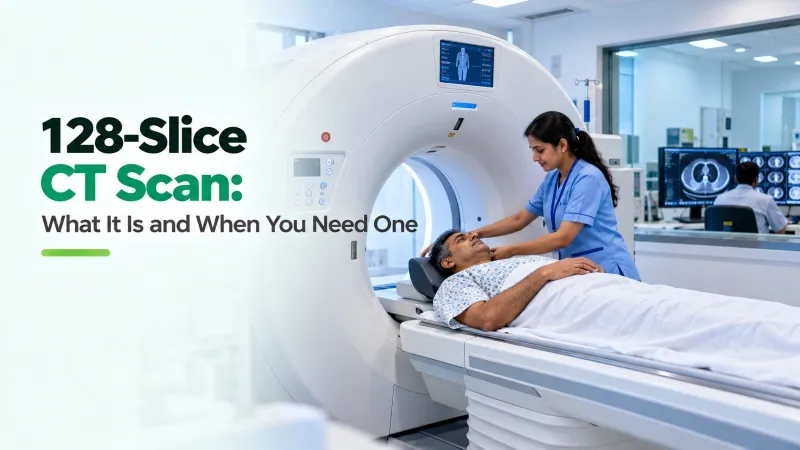
A CT (computed tomography) scan uses X-rays that rotate around the body, and a computer builds detailed cross-section images – like slices of bread. Unlike a normal X-ray, CT shows bones, organs, blood vessels and soft tissues clearly, and can create 3D pictures.
What Does “128-Slice” Mean?
The number of slices refers to how many image rows the scanner captures in each rotation. A 128-slice CT captures many slices at once, which means:
- Faster scans – most scans take only seconds, helpful for children, elderly and injured patients
- Sharper detail – small problems are easier to see
- Better imaging of blood vessels – useful for CT angiography as advised
- Fewer motion problems – less blurring from breathing or movement
When Is a CT Scan Needed?
- Head: suspected stroke, head injury, severe headache
- Chest: lung infections, pneumonia, chest injury, lung nodules (HRCT for ILD)
- Abdomen: kidney stones, appendicitis, abdominal pain, tumours
- Spine and bones: fractures and complex injuries
- Emergencies: road accidents and trauma, where speed matters
- Guiding procedures: such as CT-guided biopsy
Plain CT vs Contrast CT
Some scans need a contrast dye, given through a vein (and sometimes by mouth), to show blood vessels and organs more clearly. You may feel a brief warm sensation – this is normal.
How to Prepare
- Bring your doctor’s prescription and previous reports or scans
- For contrast scans, fasting for about 4–6 hours is often advised
- A kidney function test (creatinine) may be needed before contrast
- Tell the staff if you are pregnant, have diabetes, kidney disease or allergies, or take metformin
- Remove metal items such as jewellery and belts
Is a CT Scan Safe?
CT uses X-ray radiation, and modern scanners use dose-reduction techniques. The radiation is controlled and the scan is done only when its benefit – an accurate, fast diagnosis – outweighs the small risk. CT is generally avoided in pregnancy unless essential.
CT Scan vs MRI
| Factor | CT scan | MRI |
|---|---|---|
| Speed | Seconds to a few minutes | Usually 20–45 minutes |
| Uses | Emergencies, bones, lungs, abdomen, bleeding | Brain, spine, joints, soft tissues |
| Radiation | Uses X-rays | No radiation (magnetic field) |
| Noise and space | Quiet, open ring | Noisy, narrow tunnel |
Read more about our CT scan and X-ray services.
Why Choose Pluto Hospital, Himatnagar
Pluto Super Speciality Hospital, Himatnagar has a 128-slice CT scanner, digital X-ray, sonography and an automated lab on site, with 24×7 emergency imaging. Reports are shared with your treating doctor, so diagnosis and treatment can start without delay.
Conclusion
A 128-slice CT scan gives fast, detailed images that help doctors diagnose strokes, injuries, stones, infections and many other conditions quickly. With simple preparation and a controlled radiation dose, it is a safe and powerful test when your doctor advises it. Having a CT scanner available 24×7 close to home can save precious time in emergencies.
Need a CT scan?
128-slice CT available 24×7 at Pluto Hospital, Himatnagar. Call to book or ask about preparation.
Frequently Asked Questions
How long does a CT scan take?
The scan itself usually takes only seconds to a few minutes. With preparation, the whole visit may take longer, especially for contrast scans.
Do I need to fast before a CT scan?
For plain CT usually not. For contrast CT, 4–6 hours of fasting is often advised – our team will tell you when booking.
Is CT scan radiation harmful?
CT uses a controlled dose of radiation. It is done only when the benefit of an accurate diagnosis outweighs the small risk.
Is CT better than MRI?
Each has its own uses. CT is faster and better for emergencies, lungs and bones; MRI is better for many brain, spine and joint problems.
Is a CT scan available at night in Himatnagar?
Yes. Pluto Hospital’s 128-slice CT is available 24×7 for emergencies.