
Key Takeaways
- A hernia is a bulge where tissue pushes through a weak spot in the abdominal wall.
- Hernias do not heal on their own – surgery is the only permanent treatment.
- A painful, hard bulge that will not go back, with vomiting, is an emergency.
- Both laparoscopic and open repair are effective; the choice depends on the hernia and the patient.
- Planned surgery is safer and simpler than emergency surgery.
A hernia often starts as a small, painless bulge that appears when you cough or stand and disappears when you lie down – so many people put off treatment. This guide explains why hernias need attention, when surgery is needed and how laparoscopic and open repair compare.
What Is a Hernia?
A hernia happens when part of the intestine or fatty tissue pushes through a weak area in the muscle wall of the abdomen. Lifting heavy weights, chronic cough, constipation, pregnancy, obesity and previous surgery can all increase the pressure that causes it.
Common Types of Hernia
- Inguinal hernia – in the groin, most common in men
- Umbilical hernia – at or near the navel
- Incisional hernia – through the scar of a previous operation
- Femoral hernia – in the upper thigh, more common in women
- Hiatus hernia – part of the stomach slips into the chest, often causing acidity
Symptoms
- A bulge in the groin or abdomen that gets bigger on standing, coughing or straining
- Heaviness, dragging or aching, especially at the end of the day
- Discomfort while lifting or bending
Do All Hernias Need an Operation?
Hernias do not go away on their own and tend to grow with time. Belts and trusses only hold the bulge in temporarily. Surgery is the only permanent treatment. In some patients with a very small, painless hernia, a surgeon may suggest watchful waiting – but most hernias are best repaired in a planned way before complications develop.
Emergency Signs – Go to Hospital Immediately
A strangulated hernia is an emergency. If the bulge becomes hard, very painful, red or will not go back in – especially with vomiting, inability to pass gas or a swollen belly – the blood supply to the trapped intestine may be cut off. This needs urgent surgery.
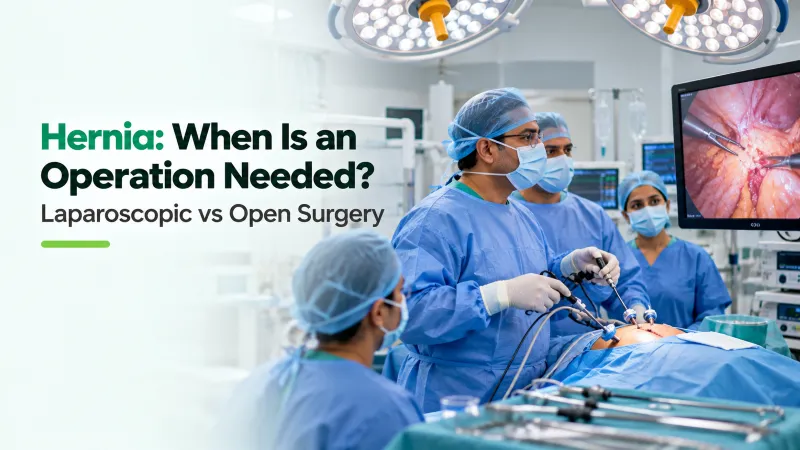
Laparoscopic vs Open Hernia Repair
| Factor | Laparoscopic | Open |
|---|---|---|
| Cuts | 3 small keyhole cuts | One larger cut over the hernia |
| Pain after surgery | Usually less | Usually a little more |
| Return to work | Often quicker | Slightly longer |
| Anaesthesia | General anaesthesia | Can be done under spinal or local anaesthesia |
| Best for | Both-side or recurrent groin hernias, many patients | Large, complicated or emergency hernias; patients unfit for general anaesthesia |
In both methods, a mesh is usually placed to strengthen the weak area and lower the chance of the hernia coming back. Your surgeon will recommend the approach that suits your hernia and health.
Recovery After Hernia Surgery
- Most patients walk the same day and go home within 1–2 days
- Light work in about 1–2 weeks
- Avoid heavy lifting for about 4–6 weeks, or as advised
- Treat constipation and chronic cough to protect the repair
Read more about hernia treatment.
Why Choose Pluto Hospital, Himatnagar
Pluto Super Speciality Hospital, Himatnagar offers surgical care with experienced surgeons and anaesthesia team, Class 100 operation theatres, sonography and 128-slice CT on site, a 12-bed ICU and 24×7 emergency. Cashless insurance and clear cost guidance help families plan surgery without stress.
Conclusion
A hernia will not heal by itself, and waiting too long can turn a simple planned operation into an emergency. Both laparoscopic and open repair work well when chosen correctly. If you notice a bulge in the groin or abdomen, get it checked by a general surgeon early.
Noticed a bulge in your groin or abdomen?
Consult our surgical team at Pluto Hospital, Himatnagar.
Frequently Asked Questions
Can a hernia heal without surgery?
No. A hernia does not heal on its own. Belts only give temporary support; surgery is the only permanent treatment.
Is hernia surgery painful?
It is done under anaesthesia. Mild pain after surgery is controlled with medicines and usually settles within a few days.
Which is better – laparoscopic or open hernia surgery?
Both are effective. Laparoscopic repair often means less pain and quicker return to work, while open repair suits large, complicated or emergency hernias. Your surgeon will advise.
Can a hernia come back after surgery?
The chance is low when mesh is used, but it can recur. Avoid heavy lifting during recovery and treat cough and constipation.
When is a hernia an emergency?
If the bulge becomes hard, very painful or will not go back, especially with vomiting or a swollen belly, go to emergency immediately.